End-to-end AD Project
Simulation-Based End-to-End Autonomous Racing
This project develops an end-to-end autonomous racing policy through simulation-based learning and Sim-to-Real validation. The research connects a lightweight multimodal perception backbone, expert-policy imitation, reinforcement-learning fine-tuning, and context-aware policy design.
My work covers policy pre-training and post-training, reinforcement learning, and context-aware methods. The project builds on initial BEV-based behavior-cloning experiments and simulation-to-vehicle test environments, while extending the learning pipeline and system design toward more demanding racing behavior. Higher control rates, improved lap times, and reliable transfer remain research objectives.
End-to-End Architecture
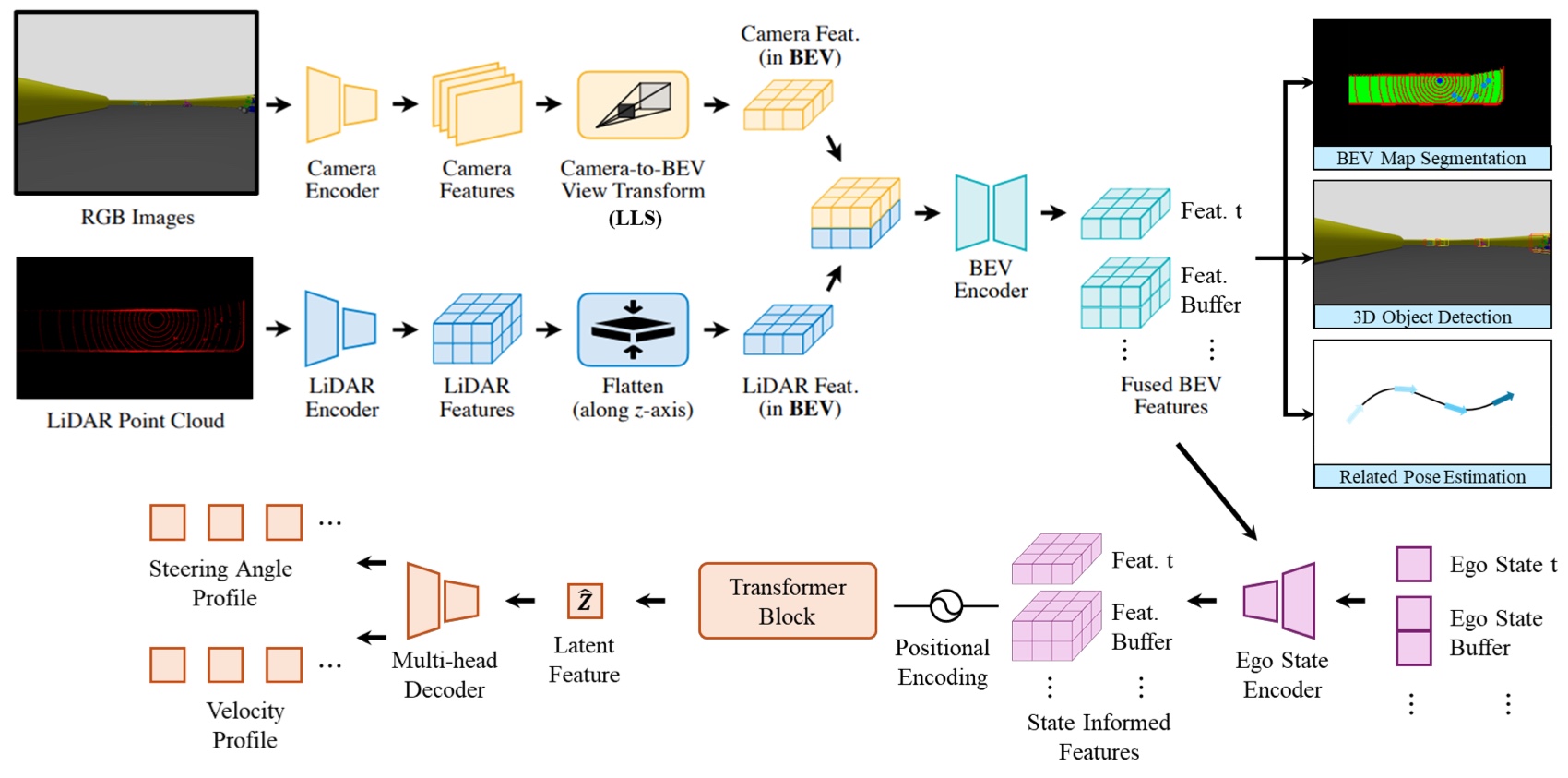
The architecture combines front-camera images and 3D LiDAR observations in a bird’s-eye-view (BEV) representation. Camera and LiDAR encoders feed a fused BEV backbone, with auxiliary tasks for map segmentation, object detection, and relative-pose estimation.
Buffered BEV features are combined with encoded ego-vehicle state and temporal information. A transformer block produces a latent representation, and a multi-head decoder outputs steering-angle and velocity profiles. The backbone design considers racing-specific regions of interest and the sensing configuration available on the platform.
Policy Pre-Training
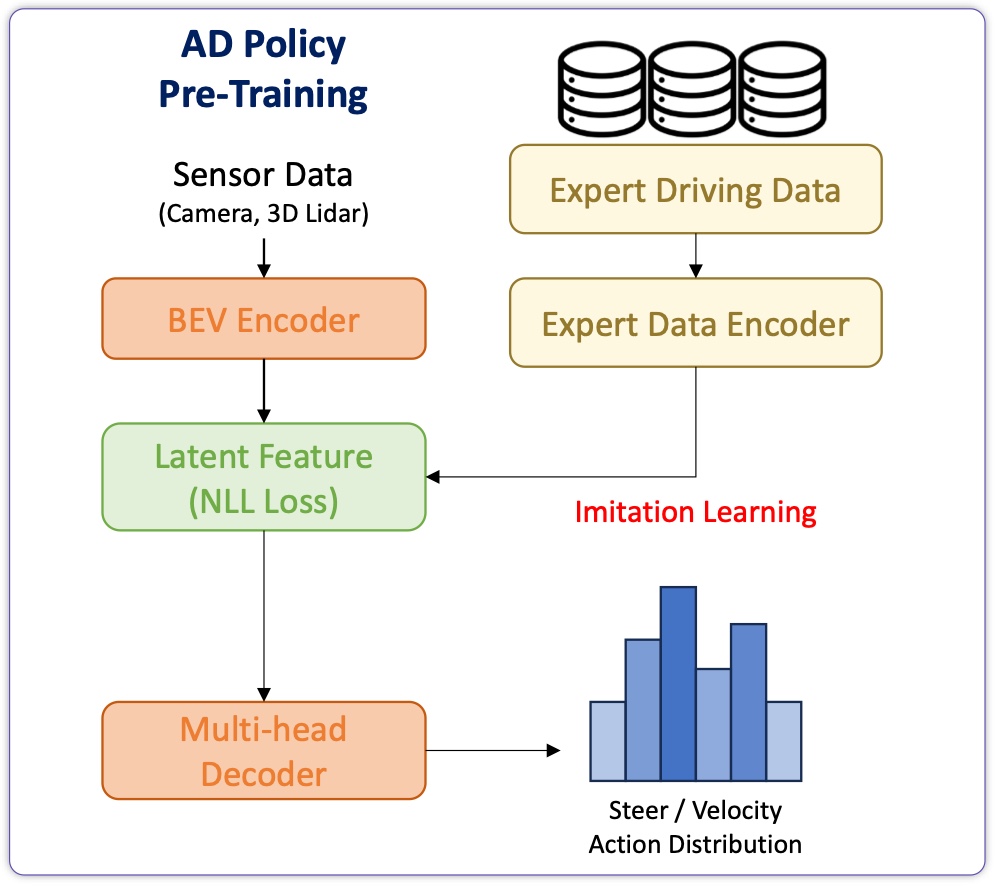
The initial policy is trained through imitation learning from an MPC-based racing expert. The expert combines track-progress objectives with collision-avoidance constraints informed by predicted opponent motion and uncertainty, providing structured driving demonstrations.
The pre-training design aligns sensor-derived latent features with expert information through a negative log-likelihood objective. The multi-head decoder produces steering and velocity action distributions, establishing a policy that can subsequently be refined through interaction with the environment.
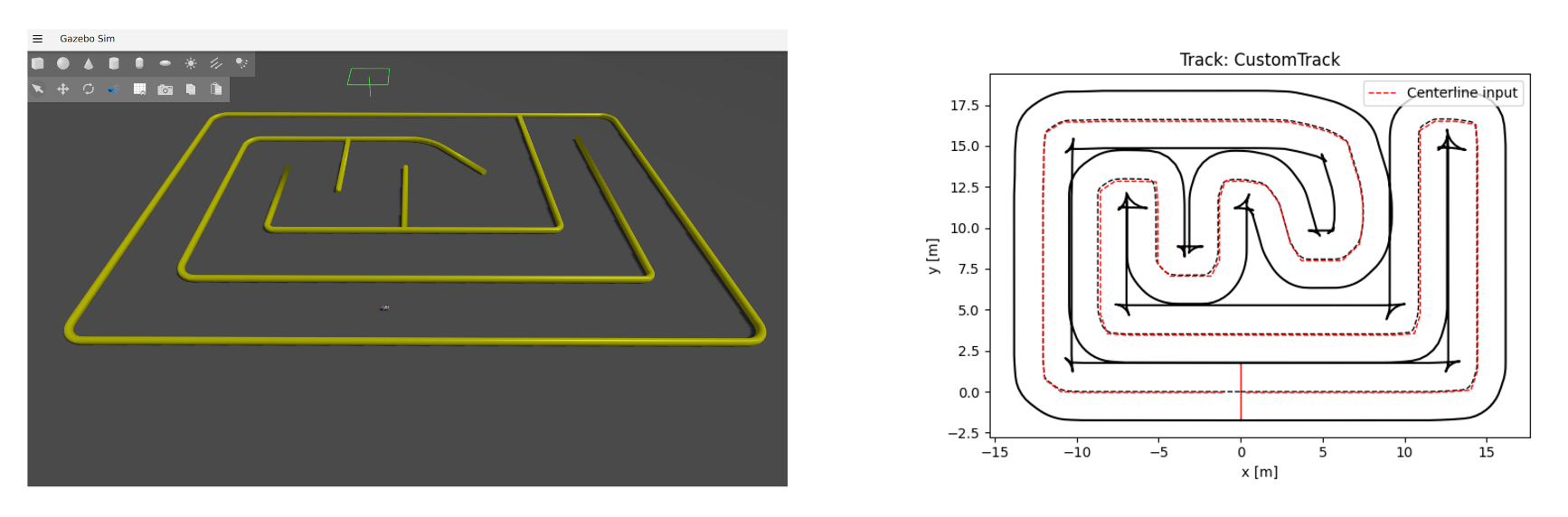
The following clips show trajectory visualizations from the imitation-learning experiments.
Policy Post-Training and Curriculum
Post-training refines the initialized policy using Proximal Policy Optimization (PPO) and parallel simulation rollouts. Steering and velocity use separate action distributions, while expert-data updates remain alongside reinforcement-learning updates to limit drift from the demonstrated policy.
The reward design combines collision and overtaking outcomes with denser signals for track progress, progress relative to an opponent, and smooth steering and acceleration changes. These signals support learning throughout a rollout rather than relying only on occasional terminal events.
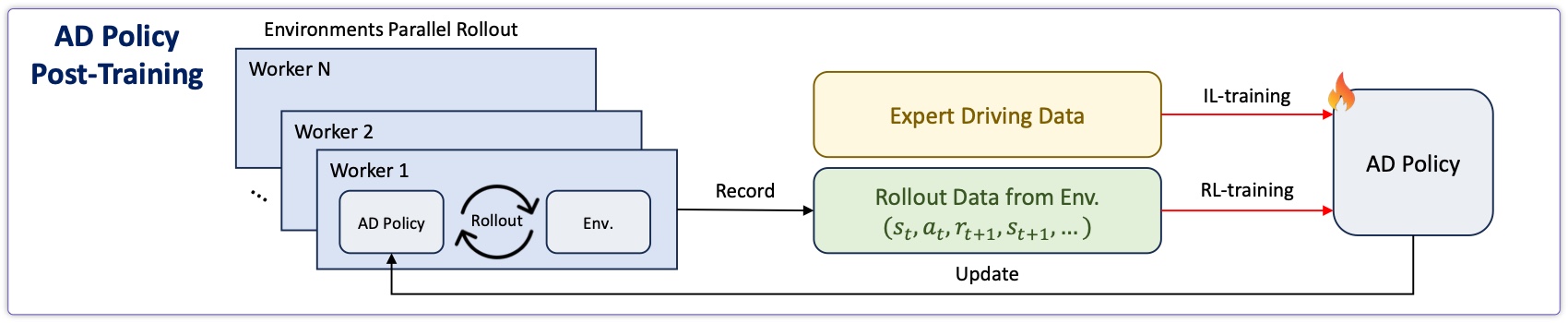
The curriculum introduces racing objectives in stages: first maximizing progress around a track, then learning overtaking through relative progress, and finally incorporating close-interaction collision penalties. This staged design aims to reduce unnecessary early exploration before adding more demanding interactions.
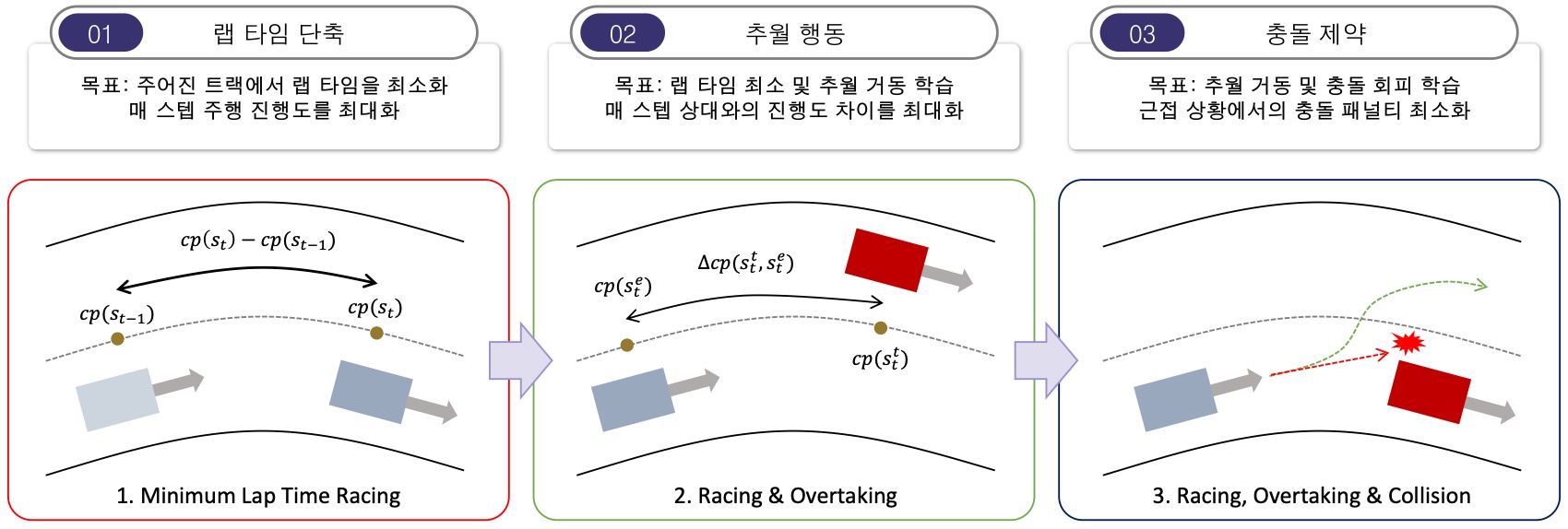
The rollout sequence below shows Gazebo racing behavior at different training iterations for overtaking and collision-aware settings.
Context-Aware Policy Design
The situation-awareness work explores latent context inference for changing driving conditions. Context factors of interest include road friction, opponent-speed scale, steering aggressiveness, and track-segment type. The aim is to help the policy interpret the current situation beyond an isolated raw-sensor observation.
The design also considers a validity mask so that context is used when it contributes meaningfully to the dynamics. This reduces unnecessary dependence on context and supports studying generalization under unfamiliar conditions.
Simulation and Sim-to-Real
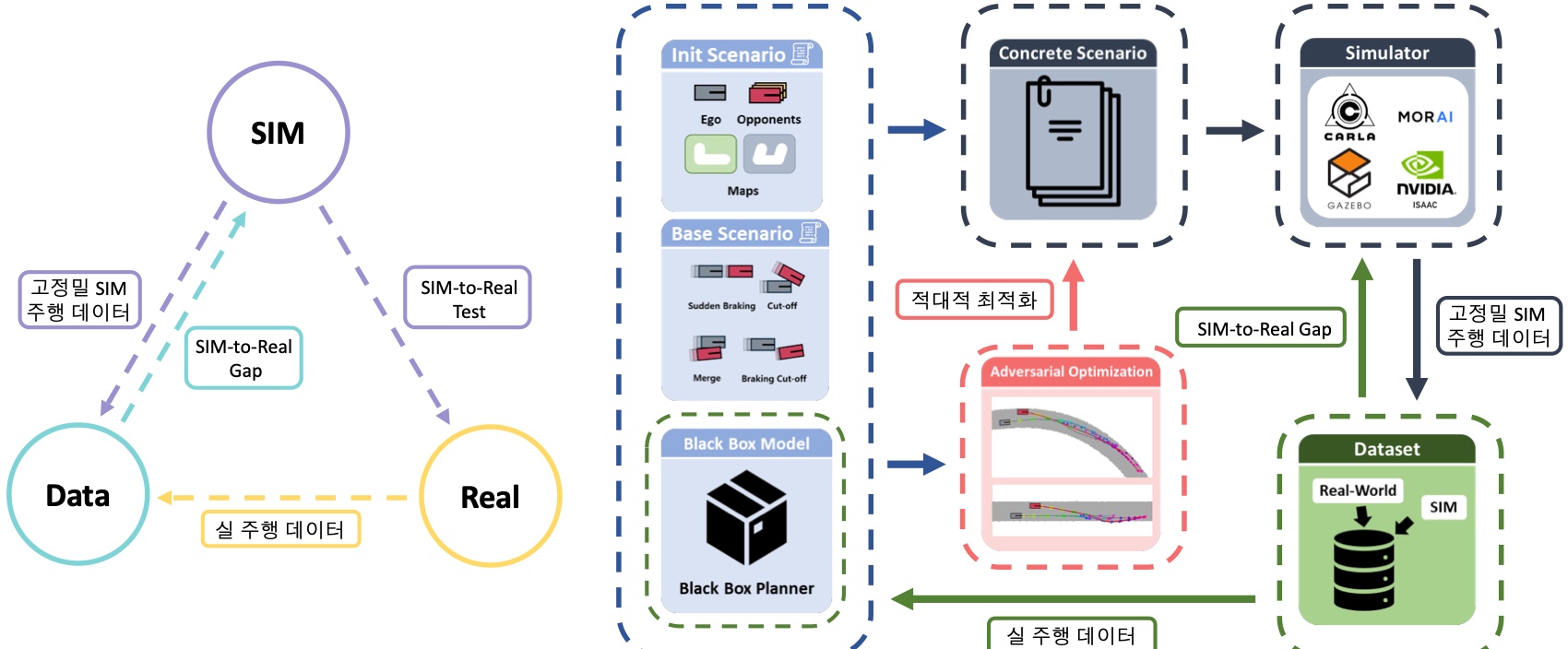
The development loop connects simulation, driving data, and vehicle tests. Parallel environments support learning, while system identification and real-data-based dynamics tuning address differences between simulated and physical behavior.
The Sim-to-Real strategy includes domain randomization, sensor-noise injection, asynchronous sensor handling, and targeted use of real driving data. Scenario generation and closed-loop testing are part of the broader validation design, including interactions such as merging, cut-ins, and sudden braking.
Reliability and Runtime Design
The wider system design explores uncertainty-based policy gating, conservative fallback behavior, and physics-informed stability and collision-risk assessment. Training and deployment optimization directions include mixed precision, distributed learning, model compilation, quantization, TensorRT, and reducing communication overhead. These are development strategies to evaluate alongside driving performance.
Contribution
I work on policy pre-training and post-training, reinforcement learning, and context-aware methods. My focus connects expert-guided initialization with rollout-based policy improvement, reward and curriculum design, and situation-aware policy representations for autonomous racing.